Genuine GHK-Cu, also known as Copper Tripeptide-1, has a theoretical copper content of about 15.8% by weight — but that figure holds only for the salt-free complex C14H22N6O4Cu, molecular weight approximately 401.9 g/mol. Commercial material is often supplied as a salt form, usually hydrochloride or acetate, and the counter-ion adds weight that lowers the measured copper percentage. So 15.8% is a chemistry reference point, not a release specification: China’s YY/T 10005—2026 industry standard sets the requirement at ≥13.0% copper, determined by HPLC, and sets separate tripeptide content tiers for salt-free, hydrochloride and acetate material. Copper content is also not the same as HPLC purity: purity tells you how much of the chromatographic profile is the target compound, while copper content confirms how much copper is present in the material. Read any copper figure together with the stated salt form, the assay method, and the batch it belongs to.
1. What Copper Content Means for GHK-Cu
GHK-Cu is a copper complex of the tripeptide GHK. For B2B raw-material sourcing, “copper content” means the weight percentage of copper within the supplied GHK-Cu material, not the percentage of peptide purity shown by HPLC.
The identity facts normally used for the basic calculation are:
- Ingredient name: GHK-Cu / Copper Tripeptide-1
- CAS: 89030-95-5
- Molecular formula: C14H22N6O4Cu
- Molecular weight: approximately 401.9 g/mol
- Atomic mass of copper: approximately 63.55 g/mol
The theoretical copper content is calculated as:
Copper content = copper atomic mass ÷ molecular weight × 100
63.55 ÷ 401.9 × 100 ≈ 15.8%
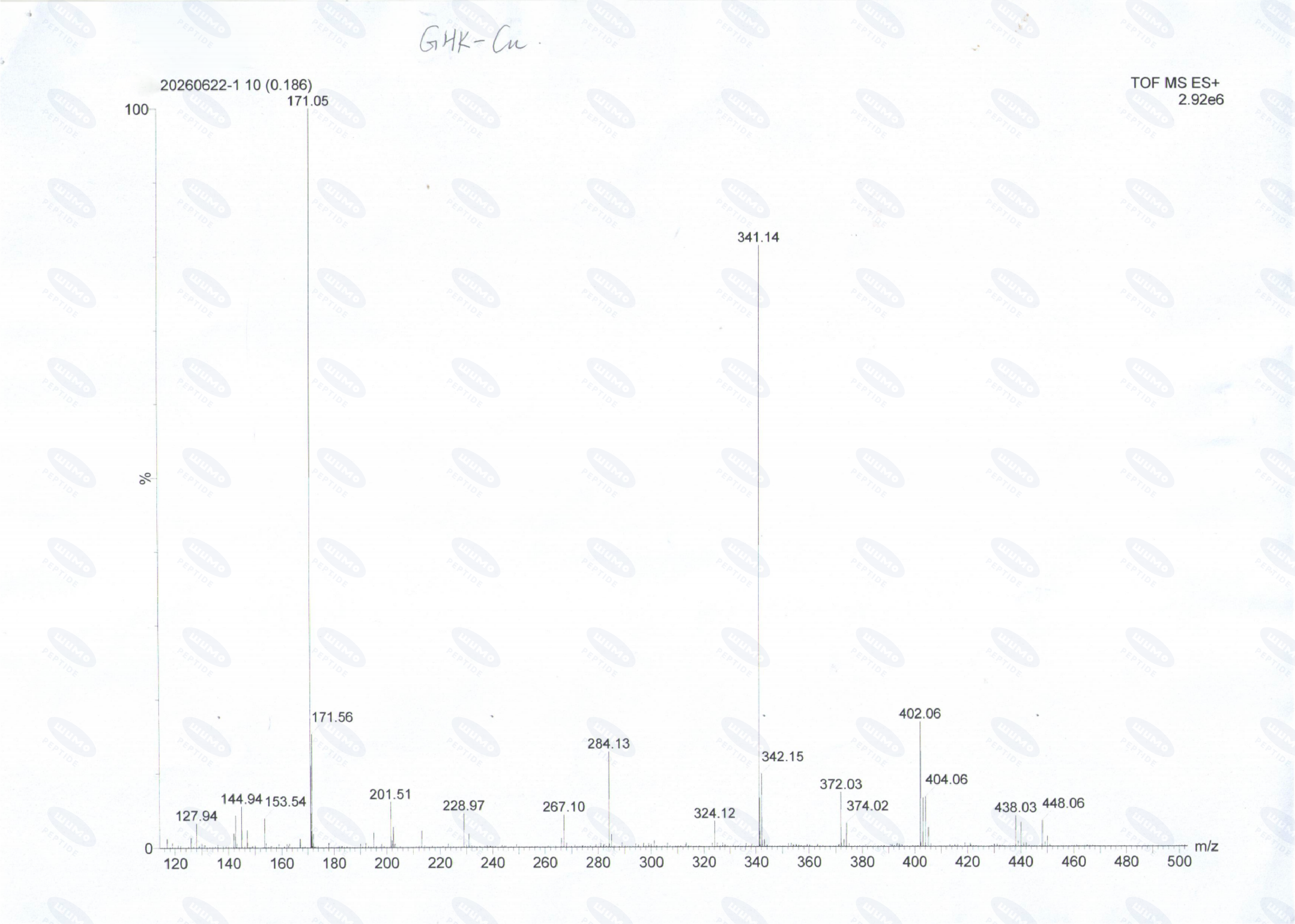
That calculation assumes the salt-free complex. If the material is a hydrochloride or acetate salt, the counter-ion raises the molecular weight and the copper percentage falls accordingly, which is why YY/T 10005—2026 sets its copper requirement at ≥13.0% rather than at the theoretical 15.8%. The 15.8% figure is a theoretical chemistry value derived from the formula. It should not be treated as a universal commercial release specification, because real batch results depend on the supplier’s material form, salt form, analytical method, moisture, residual salts, assay basis, and COA reporting format. For a purchasing decision, the buyer should confirm the copper assay on the current batch COA, not rely only on a product page or old specification sheet.
For product-level sourcing information, buyers can review WUMO’s GHK-Cu / Copper Tripeptide-1 product page. For smaller packaged material formats, see the GHK-Cu vial form.
2. Why Purity % and Copper Content % Are Different Measurements
The most common sourcing mistake is to read “purity” as if it also confirms copper content. It does not.
HPLC purity usually describes the relative peak area of the target compound compared with related impurities under a defined chromatographic method. It is useful for checking whether the batch has major organic impurities or degradation-related peaks. However, HPLC purity does not directly tell the buyer how much copper is present in the material.
Copper content is an elemental or assay-related measurement. It asks a different question: how much copper, by weight, is in the sample? A batch can show a strong HPLC purity result and still require a separate copper assay to confirm that the copper complex matches the intended identity and specification basis.
For B2B sourcing, this distinction matters because a buyer is not only purchasing a peptide peak on a chromatogram. The buyer is purchasing a defined copper peptide raw material. The documentation should therefore support both the organic compound profile and the copper content.
| Item | Purity % | Copper Content % |
|---|---|---|
| What it tells you | How much of the chromatographic profile corresponds to the target compound under the stated method. | How much copper is present in the material by weight under the stated assay method. |
| Typical documentation location | COA, HPLC report, chromatogram, specification sheet. | COA, assay section, elemental analysis or copper assay report. |
| Typical method concept | Chromatographic purity, commonly by HPLC. | Copper assay or elemental measurement method; exact method must be confirmed by the supplier. |
| Why buyers need it | To check related impurities, degradation profile, and batch consistency. | To confirm the copper-bearing identity and whether the batch aligns with the expected chemistry. |
| Main limitation | It does not directly measure copper content. | It does not replace purity, identity, or impurity review. |
3. How Copper Content Appears on a COA
On a GHK-Cu COA, copper content may appear under terms such as “copper assay,” “Cu content,” “copper content,” “assay of copper,” or an equivalent item in the specification table. The exact wording depends on the supplier’s COA template and analytical laboratory.
The COA should make three things clear:
- Whether copper content was tested on the current batch.
- Which method or method concept was used to measure copper.
- Whether the reported result is consistent with the supplier’s own specification basis.
A buyer should not assume that an HPLC chromatogram, by itself, proves copper content. HPLC supports purity and chromatographic consistency; a copper assay supports the copper percentage. Both pieces of documentation should be tied to the same batch number.
If a supplier provides only a generic specification sheet, ask for the current batch COA. If the COA lists HPLC purity but does not list copper content, ask whether copper content was tested separately and whether the supplier can provide the copper assay result for that batch.
WUMO’s COA / SDS / specification document center is designed to help buyers understand what documents are typically reviewed before ordering. For GHK-Cu specifically, the buyer should check whether the documentation package covers identity, purity, copper content, batch number, and traceability.
4. What a Low or Missing Copper-Content Figure Should Tell a Buyer
A copper-content result that looks materially lower than the theoretical value should not be ignored, but it also should not be judged without context. The buyer should first confirm the sample basis, analytical method, material form, moisture basis, and whether the result is reported on an as-is or dried basis. These details can change how the number is interpreted.
If copper content is absent from the COA, the buyer should treat that as a documentation gap, not automatically as proof of nonconformity. The next step is to ask the supplier whether copper content is part of the current batch release testing and whether a separate assay report is available.
However, a supplier should not use high HPLC purity as a substitute answer when the buyer asks about copper content. These are different measurements. A professional supplier should be able to explain what was tested, what was not tested, and which results apply to the current batch.
WUMO confirms identity and copper content by current batch documentation and does not lower the specification basis simply to win on price. For a deeper process checklist, buyers can also read how buyers verify GHK-Cu quality and the broader GHK-Cu B2B sourcing guide.
5. What to Confirm Before Issuing an RFQ
Before issuing an RFQ for bulk GHK-Cu, buyers should confirm the documentation scope, not only the quoted price. A low quote is not meaningful if the supplier cannot explain how the batch identity, purity, and copper content are verified.
At minimum, the RFQ should ask for:
- Product name, CAS, molecular formula, and molecular weight used by the supplier.
- Current batch COA, not only a generic sample COA.
- HPLC purity result and chromatogram for the same batch.
- Copper content result or copper assay report for the same batch.
- Testing method or method concept used for copper content.
- Batch number, manufacturing date, retest or expiry date, and packaging format.
- SDS and specification document, where available.
The buyer should also ask whether the quoted material is GHK-Cu as a copper complex, not plain GHK peptide, a blend, or a loosely described “copper peptide” material. When the purchasing team compares quotations, it should compare the documentation package together with the price, not price alone.
To request batch documentation or a quotation, buyers can use the GHK-Cu RFQ and documentation request form.
Since this was written, China has published an industry standard that puts numbers on both measurements separately: YY/T 10005—2026 specifies purity ≥ 98.0% and copper content ≥ 13.0% as distinct requirements, and determines the copper figure by HPLC rather than by an elemental method. See China's new YY/T standards for Copper Tripeptide-1 and Acetyl Hexapeptide-8.
Frequently Asked Questions
What is the copper content of GHK-Cu?
The theoretical copper content of GHK-Cu is approximately 15.8% by weight, calculated from copper’s atomic mass, about 63.55, divided by the molecular weight of the salt-free complex, approximately 401.9 g/mol. Material supplied as a hydrochloride or acetate salt reports a lower copper percentage, because the counter-ion adds weight. China’s YY/T 10005—2026 industry standard requires ≥13.0% copper, determined by HPLC. Confirm the salt form and the assay method before comparing a copper number between suppliers.
Is GHK-Cu purity the same as copper content?
No. Purity percentage usually refers to chromatographic purity, often measured by HPLC, while copper content refers to how much copper is present in the material by weight. A buyer should review both values because they answer different quality questions.
Can high HPLC purity prove that GHK-Cu has the right copper content?
No. HPLC purity can support the organic purity profile of the material, but it does not directly measure copper percentage. Copper content should be confirmed by a separate assay or elemental measurement method listed on the current batch documentation.
How do I confirm copper content before buying GHK-Cu in bulk?
Ask the supplier for the current batch COA and check whether copper content, Cu assay, or an equivalent item is reported. The result should be tied to the same batch number as the HPLC purity report and should identify the method or method concept used.
What if the COA only shows purity but no copper content?
Treat this as a documentation gap and ask whether copper content was tested separately. The supplier should not answer a copper-content question by pointing only to HPLC purity, because the two measurements are not the same.
Should every supplier report the same commercial copper-content range?
No fixed commercial range should be assumed without checking the supplier’s specification and batch COA. The theoretical value is about 15.8% by weight, but commercial release criteria and reported results are method-dependent and must be confirmed batch by batch.
What should I compare when reviewing GHK-Cu quotations?
Compare identity information, HPLC purity, copper-content documentation, batch traceability, packaging format, and document completeness together with price. A cheaper quote may not be equivalent if it lacks current batch documentation for copper content.
Related reading: why GHK-Cu quotations differ explains how purity, peptide content and copper content interact with the price on a quotation. To see these distinctions applied line by line to a real batch certificate, see how to read a GHK-Cu certificate of analysis.